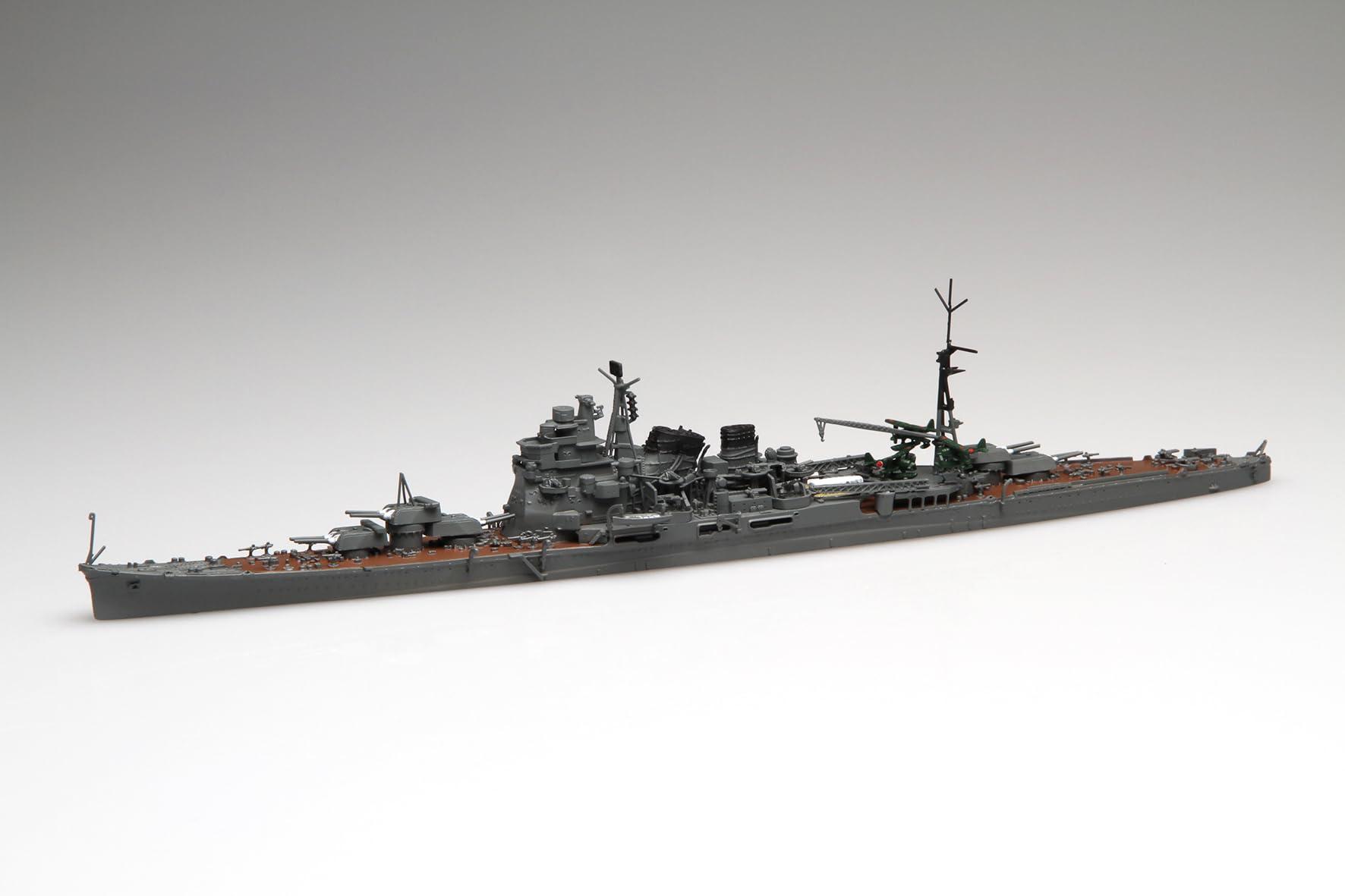
1/700 Special Series No.45 Imperial Japanese Navy Heavy Cruiser Kōgei (1944/Operation Shō-1) Plastic Model Kit
JAN
4968728433707
ASIN
B0CSMMH81K
Maker
Model No.
Color
Size
Description
Special Series - No. 45 - Imperial Japanese Navy Heavy Cruiser - 1944 - Operation Sho-Ichigo Product Description
This ship features reinforced anti-aircraft armament, Type 21, 22, and 13 radars, and numerous single-barreled machine guns, all of which are prominent during the Battle of Leyte Gulf. New parts have been added to recreate the ship's appearance.
This product is an unpainted kit that requires assembly and painting.
This is a 1/700 scale model without the bottom of the ship.
This product is made up of molds from the previous (Special Series) and newly added mold parts.
The heavy cruiser "Takao" was an improved and revised version of the previous Myoko-class cruiser, and was built as a treaty cruiser.
The first ship, "Takao," was completed at the Yokosuka Naval Arsenal in 1932, and four other ships were built, along with "Atago," "Chokai," and "Maya."
Five 20.3 cm twin turrets with an elevation angle of 70 degrees allow for anti-aircraft fire. In 1939, the ship underwent a remodeling, reducing the size of its bridge, installing a bulge, and relocating its aft mast to improve communications. At the start of the war, the ship participated in the Southwestern Front Operation, but was defeated in the Battle of Leyte Gulf in October 1944 by a torpedo attack from a U.S. submarine, losing its combat capability and retreating. The war ended in Singapore, and the ship was seized by the British and sunk at sea. This product is based on the Takao-class lead ship, Takao, as it appeared during the Battle of Leyte Gulf (October 1944). Takao and Atago feature numerous exclusive parts, including a reduced bridge and a relocated aft aft mast during prewar remodeling. New molds were used to standardize the accuracy of equipment reproductions between product release dates, and some parts were separated for ease of painting. The Type 13 radar includes newly enclosed parts with a sculpted truss structure and aerial shape. The No. 21 radar features more delicate sculpting than previous accessory parts, including the insulator base for fixing the elements on the front. The No. 22 radar uses a slide mold to recreate the open state. The 12.7 cm Twin Anti-Aircraft Gun Type A is subdivided into four parts, improving the modeling resolution from the previous two-part model. The 9-meter cutter is made into two parts for paintability, and the mount is available as a separate part, with the option of being molded as an integrated deck. The 11-meter motorboat has separate parts for paintability, including the canvas and wheelhouse/engine room canopy. Each part is painted and then assembled and glued later. The ship's boat mount features molded irregularities and light holes, enhancing the sense of precision. The chrysanthemum crest on the bow and the sidelights on the side of the bridge are available as new parts. Binocular telescope parts have been added to the air defense command post and compass bridge. Decals have been added for the stern ship's name (painted in naval colors) and the white line on the mast. The Type 96 25mm machine gun is now a standard two-part design, reducing the amount of painting required. Hull: The hull features a one-piece construction with the port and starboard sides molded as a single unit, allowing for a more stable assembly than a jointed assembly. The side bulges installed during the refurbishment are molded as a single piece. The numerous blocked and unblocked portholes along the side, as well as the surrounding external electrical wiring, are recreated with three-dimensional sculpture. Upper Deck: The upper deck is a single piece, with detailed carvings such as linoleum deck retainers and anti-slip steel decking. The upper deck's slope (camber angle) gradually decreases from port to port.
Each Deck
-Various details are reproduced, including machine gun ammunition boxes, single machine gun mounting areas, and hose reels.
-The shelter deck is a separate part, accurately recreating the torpedo equipment compartment on the lower level.
-The aircraft operation deck is a separate part, with vertical surfaces sculpted using a slide mold.
Bridge
-The distinctive large bridge structure is a single-piece part with sculpted details on all four sides using a slide mold.
-The air defense command post and compass deck are made using a slide mold, with each deck layer, including the wind protection equipment, meticulously recreated.
Main Gun Turret
-The main gun barrels have their muzzles recreated, and by adjusting the angle of attachment to the turret, you can recreate any desired elevation or depression angle.
-The seams of the heat shielding panels on the sides and top of the turret are meticulously sculpted.
Funnel
This ship features reinforced anti-aircraft armament, Type 21, 22, and 13 radars, and numerous single-barreled machine guns, all of which are prominent during the Battle of Leyte Gulf. New parts have been added to recreate the ship's appearance.
This product is an unpainted kit that requires assembly and painting.
This is a 1/700 scale model without the bottom of the ship.
This product is made up of molds from the previous (Special Series) and newly added mold parts.
The heavy cruiser "Takao" was an improved and revised version of the previous Myoko-class cruiser, and was built as a treaty cruiser.
The first ship, "Takao," was completed at the Yokosuka Naval Arsenal in 1932, and four other ships were built, along with "Atago," "Chokai," and "Maya."
Five 20.3 cm twin turrets with an elevation angle of 70 degrees allow for anti-aircraft fire. In 1939, the ship underwent a remodeling, reducing the size of its bridge, installing a bulge, and relocating its aft mast to improve communications. At the start of the war, the ship participated in the Southwestern Front Operation, but was defeated in the Battle of Leyte Gulf in October 1944 by a torpedo attack from a U.S. submarine, losing its combat capability and retreating. The war ended in Singapore, and the ship was seized by the British and sunk at sea. This product is based on the Takao-class lead ship, Takao, as it appeared during the Battle of Leyte Gulf (October 1944). Takao and Atago feature numerous exclusive parts, including a reduced bridge and a relocated aft aft mast during prewar remodeling. New molds were used to standardize the accuracy of equipment reproductions between product release dates, and some parts were separated for ease of painting. The Type 13 radar includes newly enclosed parts with a sculpted truss structure and aerial shape. The No. 21 radar features more delicate sculpting than previous accessory parts, including the insulator base for fixing the elements on the front. The No. 22 radar uses a slide mold to recreate the open state. The 12.7 cm Twin Anti-Aircraft Gun Type A is subdivided into four parts, improving the modeling resolution from the previous two-part model. The 9-meter cutter is made into two parts for paintability, and the mount is available as a separate part, with the option of being molded as an integrated deck. The 11-meter motorboat has separate parts for paintability, including the canvas and wheelhouse/engine room canopy. Each part is painted and then assembled and glued later. The ship's boat mount features molded irregularities and light holes, enhancing the sense of precision. The chrysanthemum crest on the bow and the sidelights on the side of the bridge are available as new parts. Binocular telescope parts have been added to the air defense command post and compass bridge. Decals have been added for the stern ship's name (painted in naval colors) and the white line on the mast. The Type 96 25mm machine gun is now a standard two-part design, reducing the amount of painting required. Hull: The hull features a one-piece construction with the port and starboard sides molded as a single unit, allowing for a more stable assembly than a jointed assembly. The side bulges installed during the refurbishment are molded as a single piece. The numerous blocked and unblocked portholes along the side, as well as the surrounding external electrical wiring, are recreated with three-dimensional sculpture. Upper Deck: The upper deck is a single piece, with detailed carvings such as linoleum deck retainers and anti-slip steel decking. The upper deck's slope (camber angle) gradually decreases from port to port.
Each Deck
-Various details are reproduced, including machine gun ammunition boxes, single machine gun mounting areas, and hose reels.
-The shelter deck is a separate part, accurately recreating the torpedo equipment compartment on the lower level.
-The aircraft operation deck is a separate part, with vertical surfaces sculpted using a slide mold.
Bridge
-The distinctive large bridge structure is a single-piece part with sculpted details on all four sides using a slide mold.
-The air defense command post and compass deck are made using a slide mold, with each deck layer, including the wind protection equipment, meticulously recreated.
Main Gun Turret
-The main gun barrels have their muzzles recreated, and by adjusting the angle of attachment to the turret, you can recreate any desired elevation or depression angle.
-The seams of the heat shielding panels on the sides and top of the turret are meticulously sculpted.
Funnel
Package
Size (Approx.):
Size (Approx.):
149x66x412 mm
Package
Weight (Approx.):
Weight (Approx.):
360 g
3,960 JPY (Including Tax)
Stock :
1
Scheduled Shipping:
2026-07-14
Quantity :
Reference Price from Other Stores