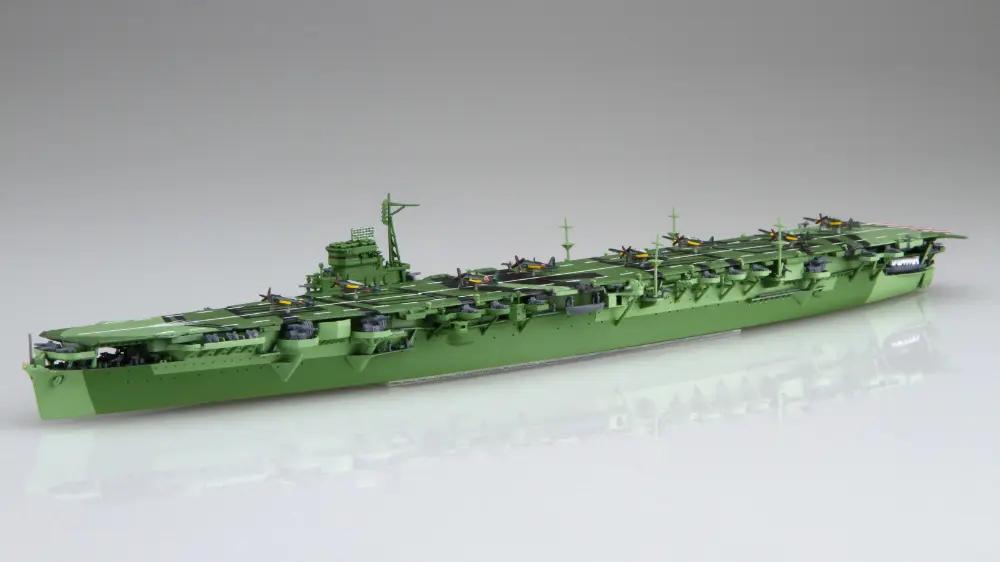
Special-17EX-1 1/700 Special Series No.17 EX-1 Imperial Japanese Navy Aircraft Carrier Amagi (with Etching Parts)
JAN
4968728433868
ASIN
B0F42J5P7B
Maker
Model No.
Color
Size
Description
Special Series No.17-EX-1 - Imperial Japanese Navy Aircraft Carrier - With Etching Parts
The second ship of the Unryu class, Amagi, arrives with etching parts included.
Amagi was built as the second ship of the Unryu class at the private Nagasaki Shipyard and completed in August 1944.
Basic plan number G16, (urgent) plan initiated construction of the Unryu, followed by plans for 15 carriers including this ship to compensate for losses after the Battle of Midway.
To shorten construction time, it proceeded as a modified design of the carrier Hiryu. Later ships like the Amagi and Katsuragi saw further simplification of their shapes.
Upon completion, the Amagi already lacked sufficient carrier aircraft and remained on standby in inland waters. She was camouflaged and moored alongside her sister ship, the Katsuragi, near the Mitsukojima Islands south of Kure Naval Port.
Hit during the July 1945 air raid on Kure, she capsized and grounded. She saw no further combat action and remained in this state until the war's end. Raised after the war, her scrapping was completed in November 1947. The Special Series is a 1/700 scale model ship reproduced above the waterline. Detailed part separation and delicate sculpting provide excellent detail reproduction in this ship model. □The molded hull parts are painted light green to match the color of the No. 22 paint used on the outer hull. □The distinctive features of each ship in the Unryu class are reproduced as separate parts. □The rear of the bridge has been extended, and a dedicated part incorporating the base of the tripod mast has been used. □The machine gun turrets added to the center of the port side and both sides of the stern have been reproduced as square turrets. □The flight deck, which tends to be monotonous when painted with latex, features a richly detailed design with a variety of sculpted elements such as aircraft arresting rings, landing arresting wires, and expansion joints. □The carrier-based aircraft include the “Zero Type 52” and “Zero Type 21 Bombing Version” aircraft owned by the 601st Air Group, which existed as a carrier-based unit after completion. and the “Suisei” and “Tenzan” bombers. □ Parts are etched and consist of two large sheets. □ The included parts primarily serve two purposes: adding details that cannot be reproduced with molded parts, and providing replacement parts for partial cutting and modification. □ Etched parts capture the intricate ship fittings that injection-molded parts cannot fully represent. □ Etching parts include handrails, ladders, Type 13 and Type 21 radar, arresting wires, elevators, aircraft propellers, etc.
□ Metal parts require painting. Use instant adhesive or rubber-based adhesive depending on the bonding location.
※ This product is made in Japan.
※ This product is a plastic model kit requiring assembly.
Brand Name: Fujimi Models (FUJIMI)
Included: Molded parts, photo-etched parts, metal parts, injection-molded parts, carrier-based aircraft (Zero Fighter Model 52, Zero Fighter Model 21 Bombing Version, Comet, Tenzan), photo-etched parts (2 large sheets), instruction sheet
Material: Plastic
Plastic Model Kit
1/700
4968728433868
Special-17EX-1 1/700 Special Series No.17 EX-1 Imperial Japanese Navy Aircraft Carrier Amagi (with Etching Parts)
(text created at , 2025-09-07)
The second ship of the Unryu class, Amagi, arrives with etching parts included.
Amagi was built as the second ship of the Unryu class at the private Nagasaki Shipyard and completed in August 1944.
Basic plan number G16, (urgent) plan initiated construction of the Unryu, followed by plans for 15 carriers including this ship to compensate for losses after the Battle of Midway.
To shorten construction time, it proceeded as a modified design of the carrier Hiryu. Later ships like the Amagi and Katsuragi saw further simplification of their shapes.
Upon completion, the Amagi already lacked sufficient carrier aircraft and remained on standby in inland waters. She was camouflaged and moored alongside her sister ship, the Katsuragi, near the Mitsukojima Islands south of Kure Naval Port.
Hit during the July 1945 air raid on Kure, she capsized and grounded. She saw no further combat action and remained in this state until the war's end. Raised after the war, her scrapping was completed in November 1947. The Special Series is a 1/700 scale model ship reproduced above the waterline. Detailed part separation and delicate sculpting provide excellent detail reproduction in this ship model. □The molded hull parts are painted light green to match the color of the No. 22 paint used on the outer hull. □The distinctive features of each ship in the Unryu class are reproduced as separate parts. □The rear of the bridge has been extended, and a dedicated part incorporating the base of the tripod mast has been used. □The machine gun turrets added to the center of the port side and both sides of the stern have been reproduced as square turrets. □The flight deck, which tends to be monotonous when painted with latex, features a richly detailed design with a variety of sculpted elements such as aircraft arresting rings, landing arresting wires, and expansion joints. □The carrier-based aircraft include the “Zero Type 52” and “Zero Type 21 Bombing Version” aircraft owned by the 601st Air Group, which existed as a carrier-based unit after completion. and the “Suisei” and “Tenzan” bombers. □ Parts are etched and consist of two large sheets. □ The included parts primarily serve two purposes: adding details that cannot be reproduced with molded parts, and providing replacement parts for partial cutting and modification. □ Etched parts capture the intricate ship fittings that injection-molded parts cannot fully represent. □ Etching parts include handrails, ladders, Type 13 and Type 21 radar, arresting wires, elevators, aircraft propellers, etc.
□ Metal parts require painting. Use instant adhesive or rubber-based adhesive depending on the bonding location.
※ This product is made in Japan.
※ This product is a plastic model kit requiring assembly.
Brand Name: Fujimi Models (FUJIMI)
Included: Molded parts, photo-etched parts, metal parts, injection-molded parts, carrier-based aircraft (Zero Fighter Model 52, Zero Fighter Model 21 Bombing Version, Comet, Tenzan), photo-etched parts (2 large sheets), instruction sheet
Material: Plastic
Plastic Model Kit
1/700
4968728433868
Special-17EX-1 1/700 Special Series No.17 EX-1 Imperial Japanese Navy Aircraft Carrier Amagi (with Etching Parts)
(text created at , 2025-09-07)
Package
Size (Approx.):
Size (Approx.):
158x64x414 mm
Package
Weight (Approx.):
Weight (Approx.):
500 g
5,362 JPY (Including Tax)
Stock :
1
Scheduled Shipping:
2026-05-13
Quantity :
Reference Price from Other Stores