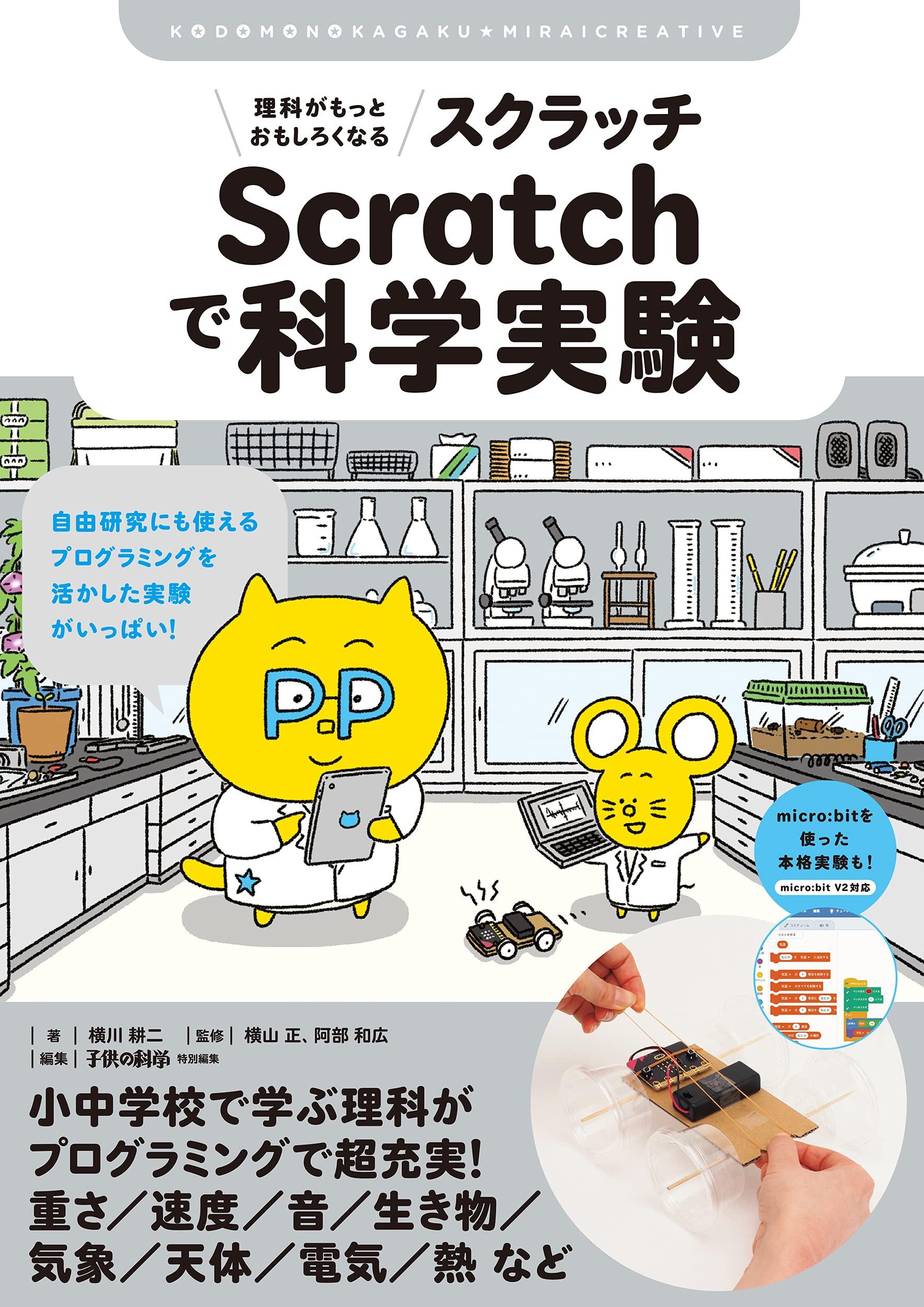
Science Gets More Interesting: Science Experiments with Scratch: Perfect for Free Research Projects! Packed with Programming-Based Experiments! (Children's Science ★ Future Creative) Koji Yokokawa, Tadashi Yokoyama, Kazuhiro Abe; Children's Science
JAN
9784416520307
ASIN
4416520301
Maker
Model No.
563020
Color
Single item
Size
Description
Make Science More Fun - Experiment with Scratch - Great for Independent Research - Full of Programming-Based Experiments - Kids' Science ** Future Creative The third installment of the "Kids' Science ** Future Creative" series features fun science experiments using Scratch. Scratch is a classic programming language for beginners. It's popular because it allows elementary school students to freely create games, animations, and more based on their own ideas. With programming now becoming a mandatory subject, it's also being widely used in elementary and junior high school classes. Using Scratch in science experiments and observations can make science experiences even more exciting. For example, if you want to compile a personalized illustrated book of plants you've observed, you can import photos of plants and have the computer classify them by species. Or, when conducting an experiment to examine the acceleration of an object, you can attach sensors to the car you built to measure actual speed changes and display them as a graph on a computer. This book introduces how to use programming in such science experiments. This book clearly explains everything from preparing materials for experiments and observations to building equipment, programming in Scratch, and experimental procedures. It covers a wide range of science topics taught in elementary and junior high schools, so you can start with any experiment. It's also perfect for summer vacation independent research. Part 1 focuses on easy experiments that can be done using only Scratch, while Part 2 introduces more advanced experiments using sensors from the micro:bit educational microcontroller board. While engaging in fun science experiments, you'll not only gain scientific knowledge and programming skills, but also learn about how programming is used in the real world. [Regarding the Discontinuation of the Camera Feature in Scratch] Due to a policy adopted by the Scratch Foundation, the developer of Scratch, the "Camera" feature in Scratch will no longer be available as of May 14, 2021. As a result, you will no longer be able to create costumes or backgrounds using the "Camera" menu in Scratch. Instead, you can take photos with a digital camera or your computer's camera app and import the image files into Scratch to carry out all of the experiments in this book. For more details, please see the special site for this book on the children's science website, "Kokanet." :
■Table of Contents
Part 1 Let's do programming experiments and observations with Scratch.
How to use Scratch/Let's measure weight with a spring/Let's observe how mold spreads/Let's measure reaction time to stimuli/Let's keep an observation record/Let's make a classification picture book/Let's make a joint puzzle/Let's make a picture book to compare sizes/Let's make a hygrometer with cellophane/Let's observe sound interference/Let's look at changes in weather data
Part 2 Let's do experiments and measurements using micro:bit.
How to use micro:bit/Let's measure the hours of sunlight/Let's investigate how heat is transferred/Let's find something that conducts electricity/Let's investigate the acceleration of a car/Let's measure the time it takes for a pendulum to swing back and forth/Let's observe the moon/Let's measure wind direction and speed
Package
Size (Approx.):
Size (Approx.):
184x13x259 mm
Package
Weight (Approx.):
Weight (Approx.):
400 g
2,324 JPY (Including Tax)
Stock :
2
Scheduled Shipping:
2026-11-06
Quantity :
Reference Price from Other Stores